Profile 01 · open-water hunter
Pied kingfisher: reading the hover
A black-and-white bird can still disappear against bright water. The pied kingfisher becomes easiest to recognise when pattern, posture and a remarkable suspended flight are read together.
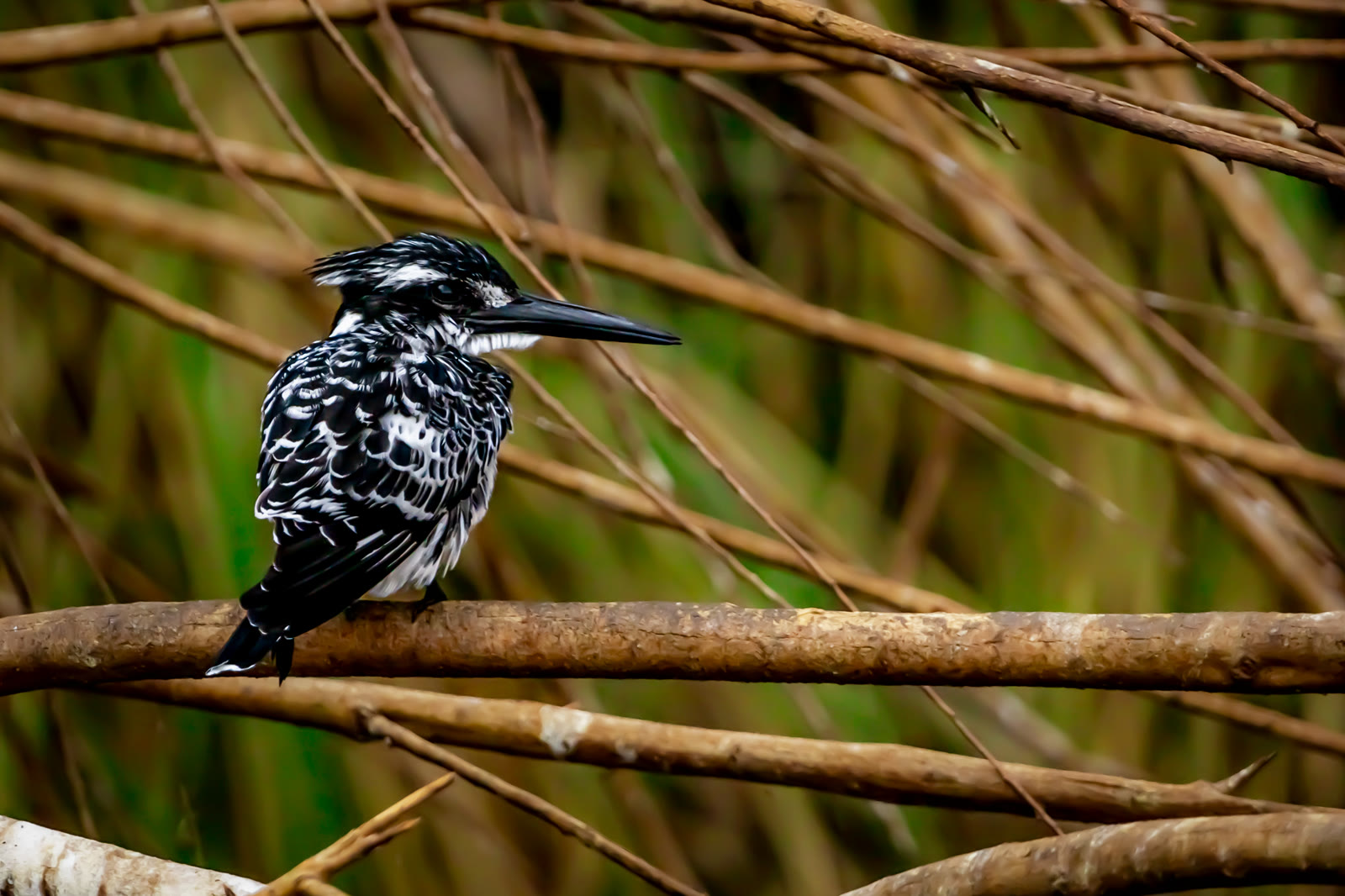

Begin with proportion. A pied kingfisher has a large head, a straight dagger-like bill and a compact body that tapers into a relatively short tail. The shape feels front-heavy when the bird sits. At a distance, its crisp black-and-white plumage often reads not as fine markings but as alternating blocks: pale below, a dark breast band, dark patches around the face and a broken dark pattern across the upperparts. Males and females differ in the breast pattern, but that detail should not be forced when light, distance or angle is poor.
The action that narrows the field
Hovering is the most memorable clue. Over open water, the bird may hold its position with rapid wingbeats, head angled down as it inspects the surface. It can shift to another point, hover again, then fold into a direct plunge. This sequence is more informative than a single flash of colour. Other birds pause in the air, and wind can make ordinary flight look almost stationary, so watch for repetition: deliberate suspension, downward focus and a fishing dive.
After entering the water, the kingfisher usually emerges quickly and flies with purpose. A successful bird may carry a fish crosswise in its bill toward a perch. A straight branch, cable, mooring or other raised position can serve as a lookout and handling station. These human-made perches do not make the setting unimportant; they work because they overlook suitable water.
Field shorthand
Shape: large head, long straight bill, compact body.
Pattern: high-contrast black and white.
Behaviour: repeated hovering and direct plunge-diving.
Position: over open water or on an exposed waterside perch.
Read the water below the bird
A hovering hunter needs a view into the water. Surface glare, waves, turbidity and the angle of the sun can all change where fishing appears practical. Instead of assuming that every calm pool should hold a bird, ask what the kingfisher could see from its chosen height. Watch the boundary between open water and slower margins, and notice whether fish activity, current seams or shade create visible contrasts.
Observation from a boat or busy bank adds another layer. Engines, approaching craft and people may alter a bird’s route. Do not ask a boat operator to chase, circle or repeatedly approach a fishing bird. A brief view from the existing course is enough. From land, remaining still near a broad view often produces more natural behaviour than walking toward each new perch.
Useful comparisons
Egyptian river scenes can include other kingfishers, so size and hunting style matter. A smaller kingfisher may show bright blue or turquoise upperparts and warm orange below rather than a monochrome body. A much larger kingfisher has heavier proportions and different colour organisation. When the bird is only a silhouette, compare bill length, wingbeat, flight height and whether it repeatedly hovers over open water.
A pied kingfisher is not identified by one checkbox. The strongest conclusion comes from several clues agreeing: the bold pattern, the oversized bill, the purposeful perch, the sustained hover and the plunge. If only one clue was visible, keep the note provisional.
Watch the complete attempt
Give the bird space to fail, reposition and try again. Do not use calls or playback to pull it closer, and never place food to manufacture a photograph. The valuable observation is the whole fishing sequence: where the bird looks, how it compensates for current and wind, and which perch it selects afterward. That behavioural line is more durable than a close portrait—and it is the line that makes this kingfisher unmistakable.
A simple sketch can preserve the sequence without demanding a closer view. Draw the bank, two hover points, the dive and the return perch. Add wind direction and surface condition. The result shows how the bird used space, not merely where it appeared. If it leaves, do not follow; finish the note from the position that allowed the behaviour to happen.