Profile 02 · bank and open water
Egyptian goose: pattern, posture and place
The Egyptian goose is often recognisable on land before it enters the water. Its tall stance, warm layered colour and dark eye patch create a striking combination—but behaviour completes the picture.
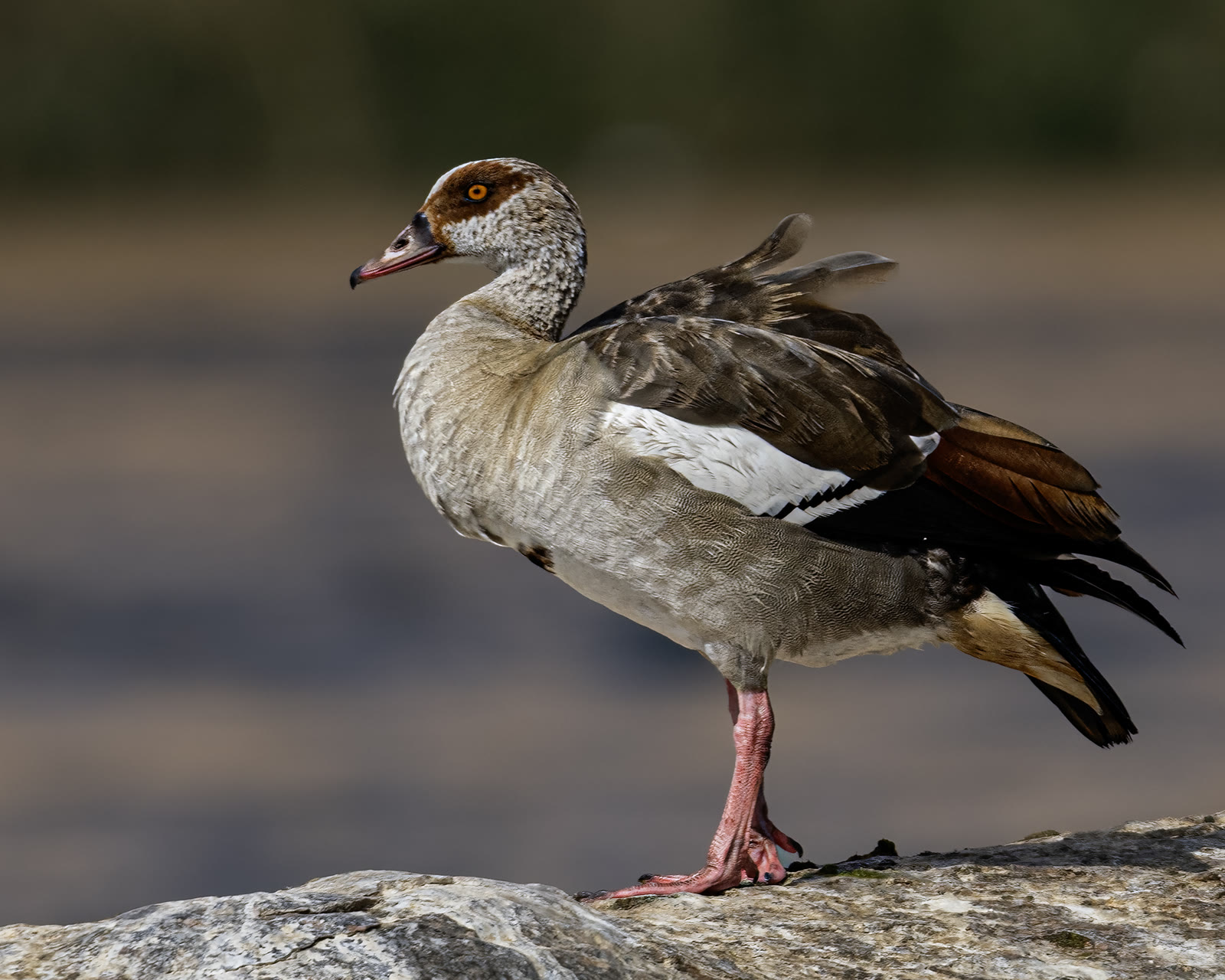

Despite its common name, the Egyptian goose is closer in build and behaviour to the shelduck group than to the heavy grazing geese many visitors know from northern parks. Look first at the silhouette: a medium-large waterbird with a fairly long neck, long pinkish legs and an upright, alert carriage. The body is warm buff to brown, while the head appears paler. A rounded dark patch around each eye can remain visible when finer feather detail has disappeared.
A pattern that changes in flight
On a standing bird, several brown tones overlap: darker back, paler face, a chest patch of variable strength and rich colour around the shoulders. Individual appearance can vary, and light can either flatten or exaggerate these contrasts. Do not expect every bird to match a single illustration. The eye patch and general structure are more stable starting points than an exact shade of brown.
When the wings open, the identification gains another strong clue. Broad white wing panels contrast with darker flight feathers, while green on the speculum may show at a favourable angle. A bird that looked muted on the bank can become sharply patterned in the air. Note also the comparatively long legs and steady, strong wingbeats. If the flight view is brief, record the white panel without turning an uncertain glimpse into a complete colour inventory.
Field shorthand
Shape: upright body, medium-long neck, long legs.
Pattern: dark eye patch on a pale head; warm brown body.
In flight: broad white wing area against dark flight feathers.
Behaviour: grazing, walking, swimming and vigilant standing.
Between grass and water
Egyptian geese use a wider visual field than a bird confined to open water. They may graze on short vegetation, walk along exposed banks, rest near a margin or swim across a channel. That flexibility explains why scanning only the water can miss them. Search the transition: irrigated greenery beside stone, mud around a quiet inlet, or a raised bank with an open line of sight.
Pairs and family groups deserve extra distance. Waterfowl can appear calm while monitoring an approach, and a direct path toward them may cut off their route to cover or water. Stop before the birds begin to walk away. If they lengthen the neck, call repeatedly or place themselves between you and smaller birds, reverse your approach rather than waiting for obvious flight.
Do not confuse place with origin
The species has a broad African history and has also established populations far beyond its native range. A familiar sight in a European park and a bird observed in Egypt may be the same species, but local status, movement and management context are not interchangeable. Wingline Egypt uses the Egyptian river setting to teach field characters; it does not infer origin, residency or migration from a single encounter.
Other brown waterbirds can share a shore. Compare the eye pattern, leg length and wing display rather than relying on body colour alone. Ducks generally sit lower and may show different bill proportions. A true goose often has a bulkier, more uniformly structured head-and-neck profile. The Egyptian goose’s combination of high stance, facial patch and contrasting open wing is much stronger than any isolated feature.
Notice the social distance
Watch how much space birds maintain between one another. A relaxed pair may feed with repeated head-down movements, then raise the head to scan. Tension can show as a stiffened neck, short rush or displacement without a prolonged fight. These small negotiations reveal how a seemingly empty lawn or bank is divided.
Feeding is not an invitation to offer bread or scraps. Supplemental food can alter behaviour, concentrate birds and degrade water quality. Observe the natural choice instead: what the bird crops, how long it stays on land and which route it uses back to water. Those details turn a bright pattern into an ecological portrait while leaving the bird free to set the terms.