Profile 04 · rest site in the current
Rocky islet rest: a platform between currents
A low patch of stone can be more than empty space between banks. For grey herons and great cormorants, it offers a dry pause, a broad view and separation from some shore-level disturbance.
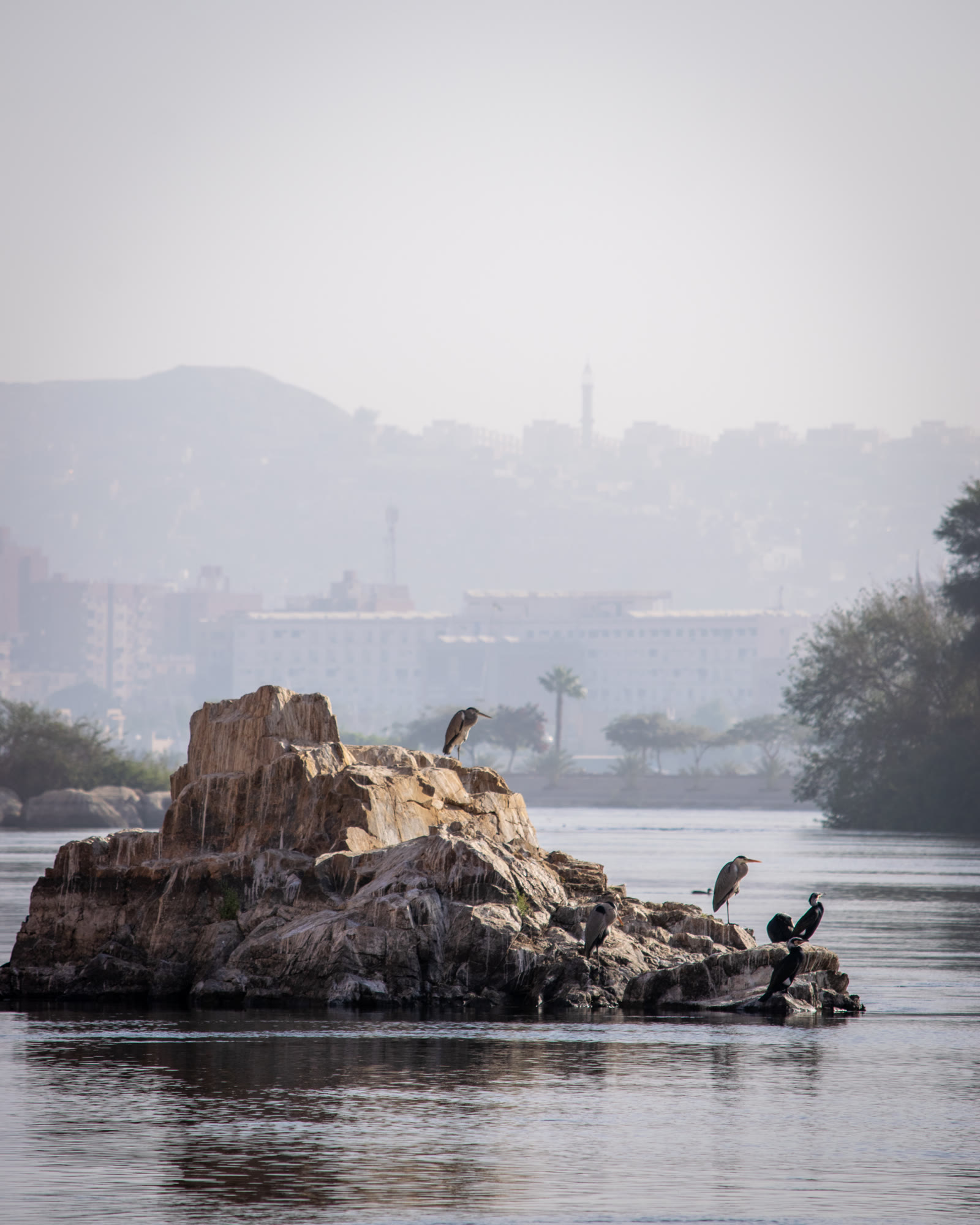

An islet does not need vegetation to function as bird habitat. Height above the surface, access from deep water, exposure to sun and a clear view can make bare rock valuable. Seen from a distance, the birds may look like dark and pale punctuation. The first task is not to count species but to understand the platform: which rocks stay dry, which slope into water and which positions offer an unobstructed route to flight.
Two bodies built for different work
Grey herons stand high on long legs. Their spear-like bills and folded S-shaped necks produce an angular silhouette even while resting. A settled bird may appear compressed, but the long limbs remain obvious when it changes position. Grey upperparts, a pale head and dark head markings distinguish an adult under good light; structure is safer when glare removes detail.
Great cormorants sit lower and heavier. The body is elongated, dark and solid, with a long neck and a bill that ends in a subtle hook. On the water, much of the body can ride low; on a rock, the large feet and rear-set legs create a more upright stance. A bird holding its wings open is a familiar cormorant image, although not every resting individual will perform it.
Silhouette test
Heron: tall legs, angular body, dagger bill, folded neck.
Cormorant: low heavy body, long neck, hooked bill, broad feet.
Shared clue: both may stand still for long periods, so wait for a turn, stretch or short walk.
Why cormorants spread their wings
Cormorants may stand with wings extended after time in the water. The posture can assist feather drying and also relates to heat and body condition; it should not be reduced to a single explanation in every circumstance. Watch duration and context. A bird newly arrived from a dive that opens its wings on an exposed stone offers a stronger behavioural sequence than a single photograph detached from what came before.
Herons use the same platform differently. A high position may support resting and scanning, while shallow margins around the rocks can create feeding edges. One bird can remain motionless as another preens or changes perch. Shared space does not imply identical needs.
The shape of available space
Bird distribution across an islet often reflects more than preference for a particular stone. Wind direction, splashing, boat approach and the distance between neighbours can all matter. Look for gaps. Does a larger bird occupy the highest point? Do arrivals land at the edge and walk inward? Does a resting individual face into wind? These questions turn an apparently static group into a sequence of decisions.
Water level can alter the size and value of exposed rocks, so an islet photographed at one moment should not be treated as permanently available. Current conditions, navigation and human use also change. Wingline Egypt does not claim that this site or these species will be present on a future visit.
Observe without creating a departure
Midstream birds can look protected, yet repeated boat approaches may remove that refuge. Do not request a closer circuit around a resting group. A vessel passing on its ordinary line gives time for one wide observation; doubling back changes the pressure. From shore, long lenses and binoculars are tools for maintaining distance, not reasons to hold attention on an uncomfortable bird.
Watch for early warning: several heads turn in the same direction, bodies become upright, preening stops or birds shuffle toward the launch edge. Flight is not the first sign of disturbance; it is the end of a sequence. Increase distance before it happens.
Make a map instead of a list
Sketch the rock outline and place birds as simple marks—tall for heron, low for cormorant. Add arrows for current and the direction of arriving boats. After several minutes, record which marks moved. This modest map captures the site’s function better than a species total alone.
A rocky islet teaches a broad field lesson: habitat can be structural rather than lush. A bare surface becomes useful because it is dry, isolated, visible and connected to feeding water. Reading those qualities helps explain the gathering while preserving uncertainty about any one bird’s motive.